You know Cornell's lines, what makes them different, and what to collect before you ask for a quote. Next time a solids-handling, self-priming, high-head or slurry job comes up, think Cornell.
Cornell builds heavy, efficient pumps in Oregon
Six parts on who Cornell is, what each line is for, the design features you'll sell on, and how to get a quote moving. Work through them in order: two quick checks at the end confirm you've got it. Your progress saves on this device.
An Oregon irrigation-pump maker that grew into every market
1946
Founded in Clackamas, Oregon, as Pump Pipe and Power
3
Plants: Oregon, Vancouver WA, and Rock Hill SC
800 hp
Tested on site, with a generator for bigger jobs
4
Independent test loops: three open, one closed
Roots: five founders built irrigation pumps for Pacific Northwest farms. That first Rain-Flow design lives on in today's RB clear-liquid pumps. The name changed to Cornell in 1951 (nobody on record knows why), and Roper Industries bought the company in 1963.
Ownership news: Xylem announced in August 2026 that it will buy Cornell, with closing expected around November. Cornell will sit in Xylem's water infrastructure group. Cornell's message to distributors: expect very little change.
Where it's built: about 90% of Cornell's pumps come from the Oregon plant (now almost 150,000 sq ft). Vancouver, Washington builds specialty pumps such as hot oil and food handling. Rock Hill, South Carolina builds the trailers and skids.
In-house work: castings come from foundries around the world, but all machining and assembly happen in Cornell's own plants. When a foundry's quality slips, Cornell moves the pattern to another foundry.
Testing: performance, NPSH, vibration, hydrostatic and noise tests, plus witness testing. Noise tests are possible but hard to schedule, because the factory runs nights and weekends.
Cornell's design focus is efficiency and weight. Their president was a design engineer and designed a large share of today's lineup. Expect heavy castings, big shafts, and efficiencies that often reach the low 80s. ISO documentation is always current, so ask if an engineer needs it.
Markets, and why Cornell asks where a pump is going
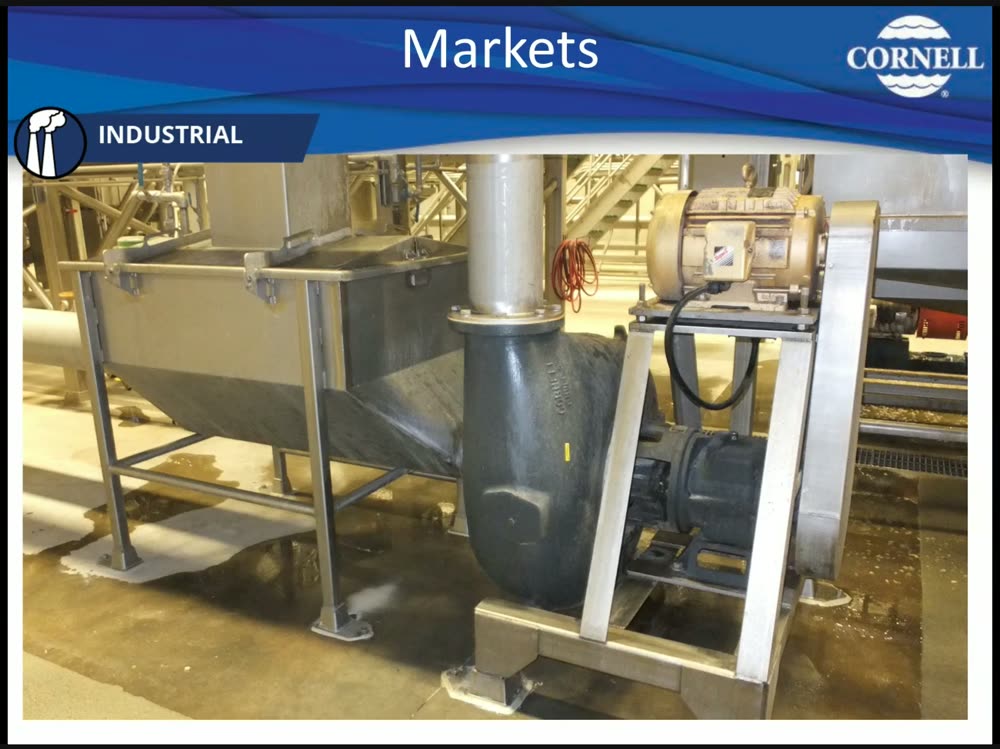
Cornell codes every sale to a market: municipal, agriculture, food processing, general industry (including refrigeration and power), mining, and oil & gas / rental. Municipal is the one market Cornell protects, because reps spend years winning those jobs. Agriculture is run by a separate Cornell team, so tell our Cornell regional manager if you want to chase it.
Always say where the pump is going. Cornell may let Rhino buy a product for one market but not another. Being upfront about the end market gets you more access to the line, not less.
In the recording: Cornell history from about 2:56, the factory and test lab 8:59, markets 17:33.
Part 2 · Product lines
What Cornell makes and where each line fits
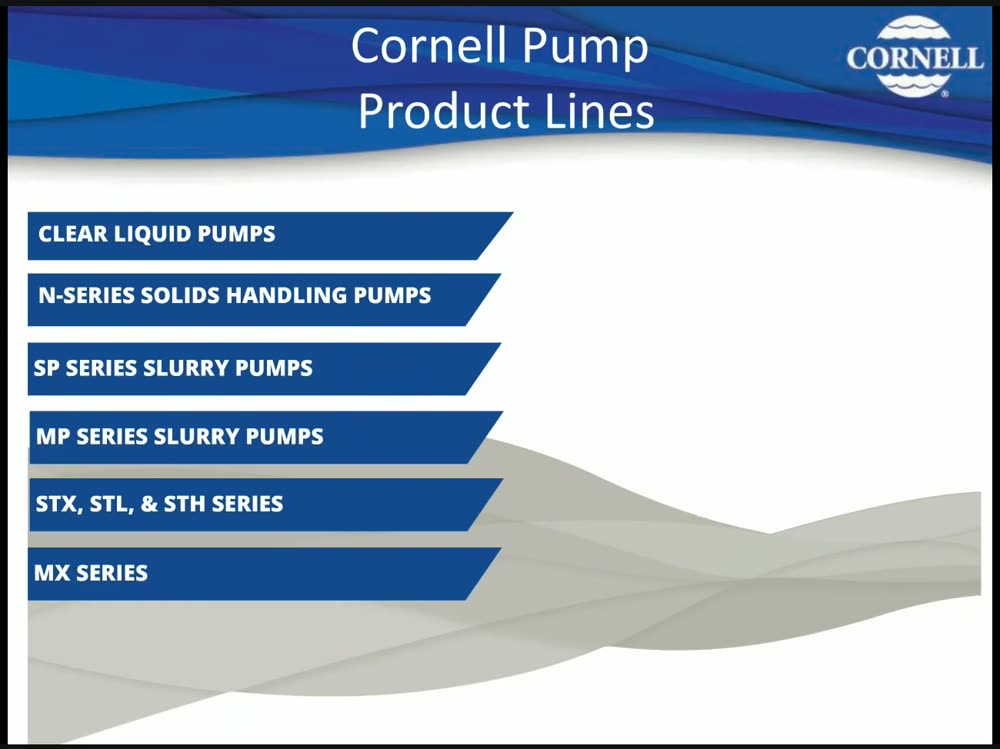
Cornell's main lines, from the visit presentation.
Open each line. Green dots show the ones you've read.
Water · irrigation · potableClear liquid: W, Y, R and H
Cornell's water pumps. The letter tells you the impeller size range: W up to about 6″, Y up to about 9″, R larger, and H for high head.
Sizes
1″–10″ discharge
Performance
Up to 7,100 gpm and 475 ft (205 psi) on Cornell's slide; the presenter cited close to 10,000 gpm and about 400 ft for the largest current models
Balancing
A hydraulic balancing line from the seal area to the front of the impeller, instead of balance holes. No turbulence at the eye means better NPSH and efficiency.
Volute
Double volute on water pumps 4″ and larger
Certification
Almost all of the clear liquid line is NSF 61 approved, typically bronze-fitted
Water recycling and aquifer injection are pushing NSF 61 into jobs outside drinking water, so it's a growing selling point.
Solids handlingN series
Cornell's most common line and biggest product mix. It's called solids handling and lives mostly in municipal, but it's sold into every market because it hits the flows and heads people want.
Sizes
4″ to 24″ (3″ models are being phased out because of the solids in today's wastewater)
Seal
Cyclo-Seal on almost every build. A cartridge seal (Flex-A-Seal welcome) means an engineering review first.
VIBS
Volute, Impeller, Backplate, Suction cover: the four parts whose materials you specify
Impellers
Enclosed (two, three or four vane) or semi-open Delta. The Delta was first designed for manure, rocks and hay.
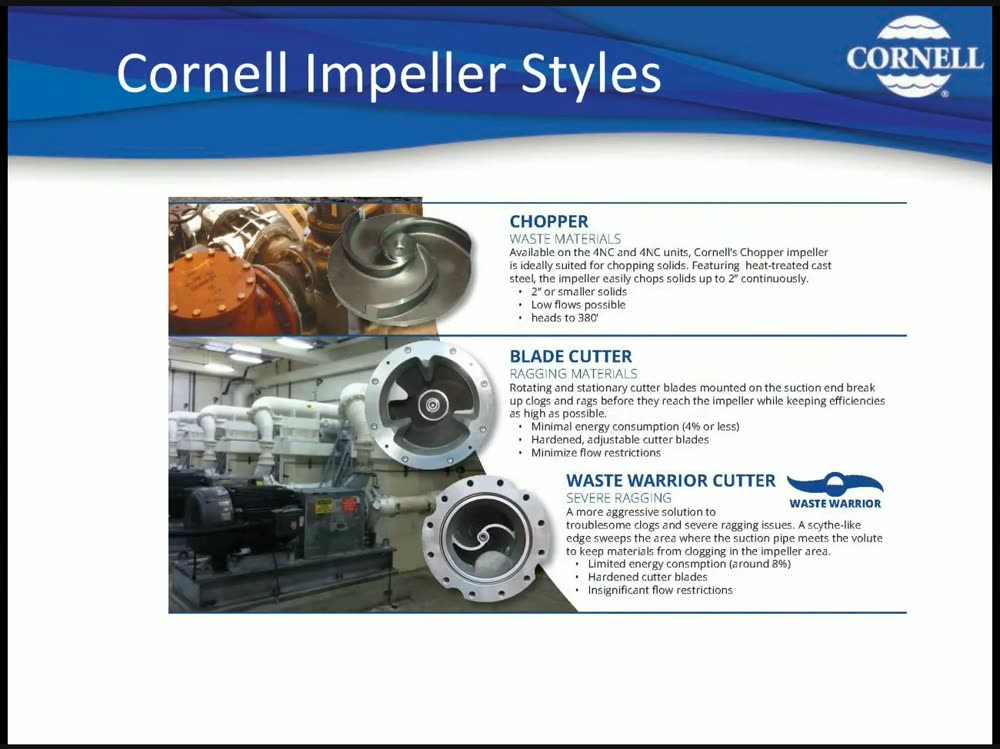
Choppers & cutters
4NC and 6NC chopper pumps; the Waste Warrior cutter is available up to 12″
Chopper, blade cutter and Waste Warrior options.
Self-primingSTX, STL and STH
Built to compete with Gorman-Rupp without being a copy. The STX is a flange-to-flange drop-in for the Gorman-Rupp T and Super T series. The STL is a high-flow version and the STH a high-head version, Cornell's answers to the Ultra V models.
Sizes
2″ to 10″; handles a 3″ solid
Drop-in
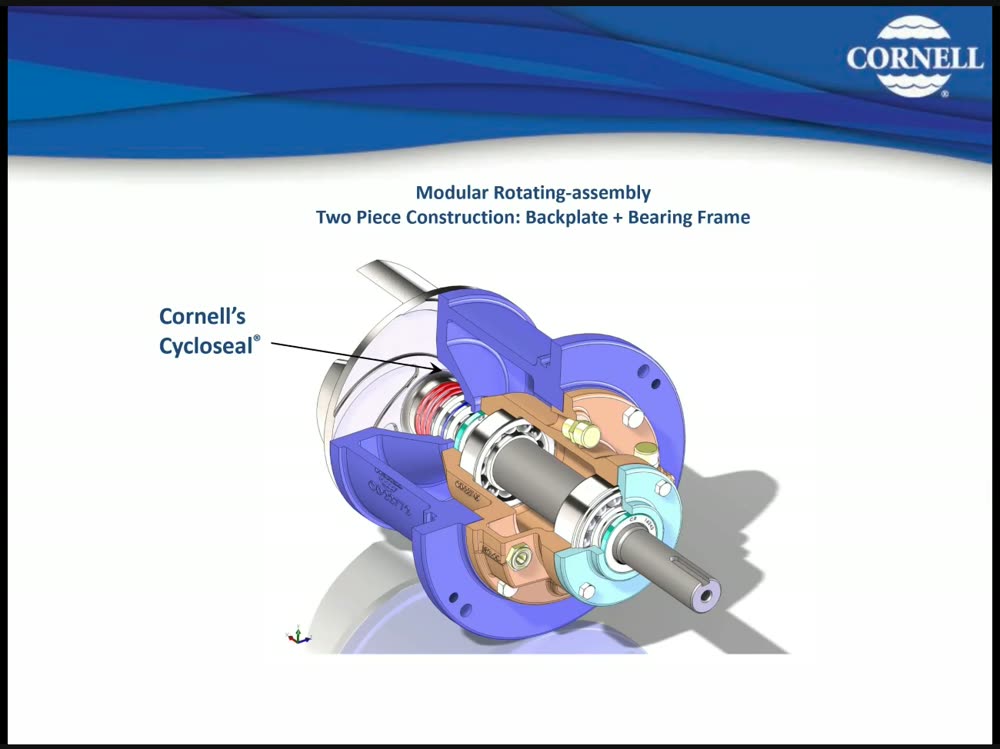
The rotating assembly (bearing frame, backplate, impeller, seal, shaft) fits a Gorman-Rupp volute. In their volute you get their performance; in Cornell's volute you get better.
Materials
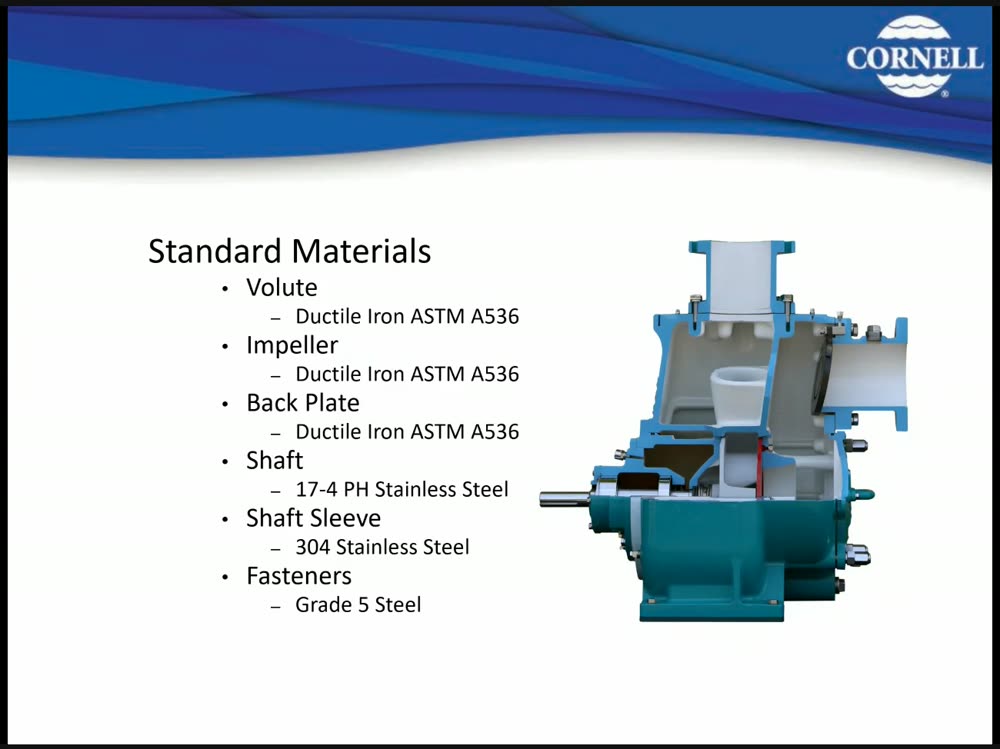
Ductile iron volute, impeller and backplate (Gorman-Rupp's standard is cast iron); CD4MCu duplex stainless option for corrosive or brackish water. 17-4 PH stainless shaft, 304 sleeve, grade 5 fasteners.
Seal
Type 2 mechanical seal in an oil-filled chamber, with a leak monitor tube that weeps fluid as an early warning. Two sight glasses: seal chamber and bearings (oil lubricated).
Efficiency
The internal discharge is cast higher so water goes straight out instead of recirculating: up to about 10 points better in some cases, with more flow and head at the same horsepower
Warranty
5 years
The rotating assembly that drops into a Gorman-Rupp volute.Standard self-primer materials.
Options include an air release valve (recommended when discharge piping is long or has many turns), a hardened cutter wear plate (a shearing plate rather than a true cutter), impeller hardening to about 450 Brinell, and engine mounting.
Abrasives · slurryMP series
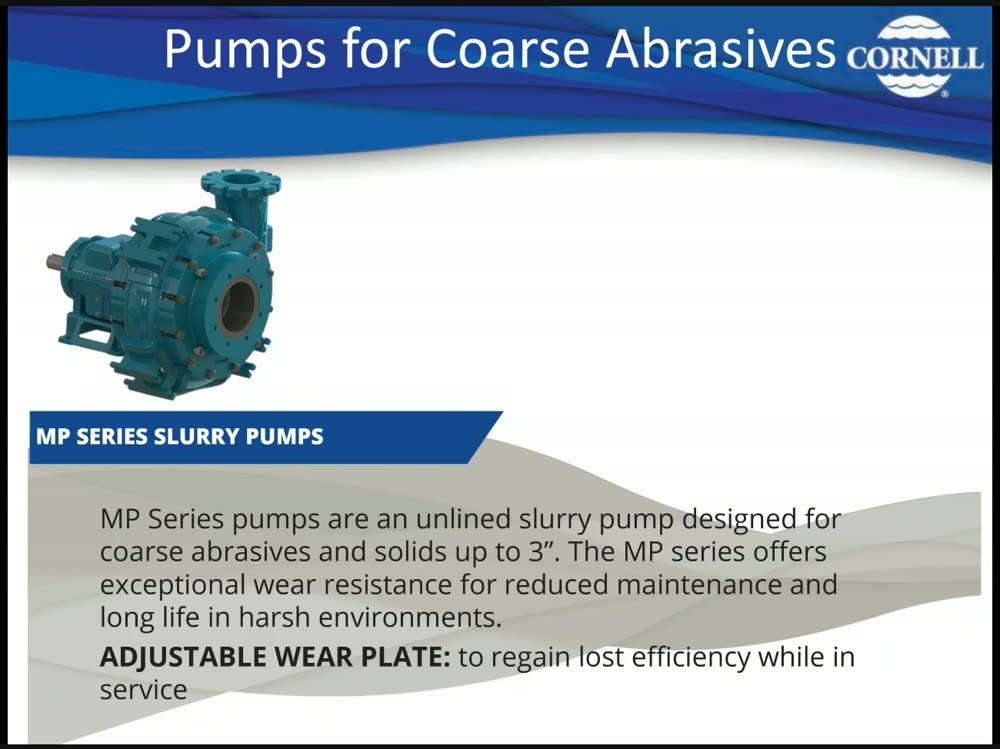
An unlined, all high-chrome slurry pump built like an N series. The presenter's favorite: they go in and last.
Duty
Coarse abrasives and solids up to 3″; slurries up to about 20% solids. Above 20%, go to a true slurry pump (SP series).
Sizes
2″ to 10″
Maintenance
Fully disassembles: volute, backplate and wear parts replace separately. The adjustable wear plate regains lost efficiency.
Build
17-4 PH shafts, about 650 Brinell high chrome, Cyclo-Seal standard. A cartridge seal needs a different cast backplate. Redi-Prime available.
MP series slide.
High pressureMX series
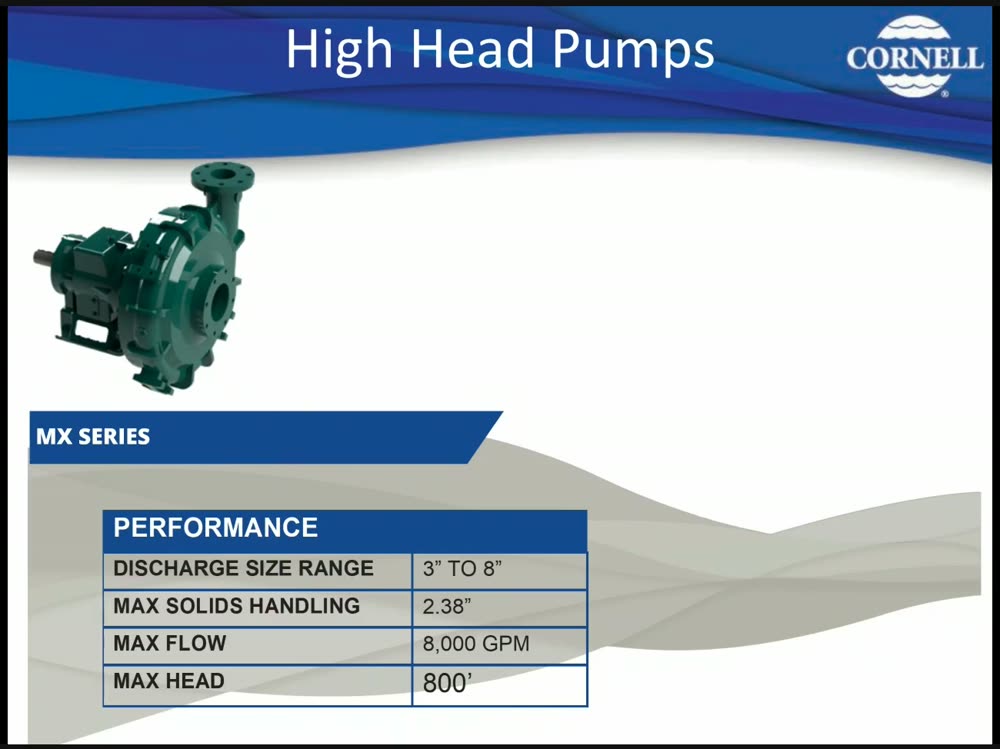
A high-pressure water pump made from materials that tolerate light abrasion. A strong fit for mine dewatering with fairly clean water.
Performance
3″–8″ on Cornell's slide: up to 8,000 gpm and 800 ft. A newer model does over 900 ft in a single stage, and the largest uses a 32″ impeller at 1,000 hp.
Solids
About 5% maximum (2.38″ max solid). Above 5%, go another direction (MP or slurry).
Materials
Ductile iron; CD4, CA6NM and other options for light abrasion
A hydro-transport pump with an expanded volute and no cutwater, so food passes through without damage. Cornell says nobody else makes one like it.
Refrigeration
Sealless ammonia pumps for cold storage. Cornell runs them at 1,800 rpm instead of the 3,600 rpm common elsewhere, so OEMs can build smaller vessels with about half the ammonia. Sold through refrigeration contractors and OEMs; Cornell can bring a refrigeration specialist onto a call.
Immersible motors
A TEFC motor with an external fan, sealed like a submersible, that can run underwater for up to 14 days. Made for dry pits that could flood: hurricane and flood-zone stations.
Submersibles
Available for hydraulics nobody else hits, but Cornell doesn't make the motor, so lead times are long
An HPP food handling installation.
PackagesTrailers and skids
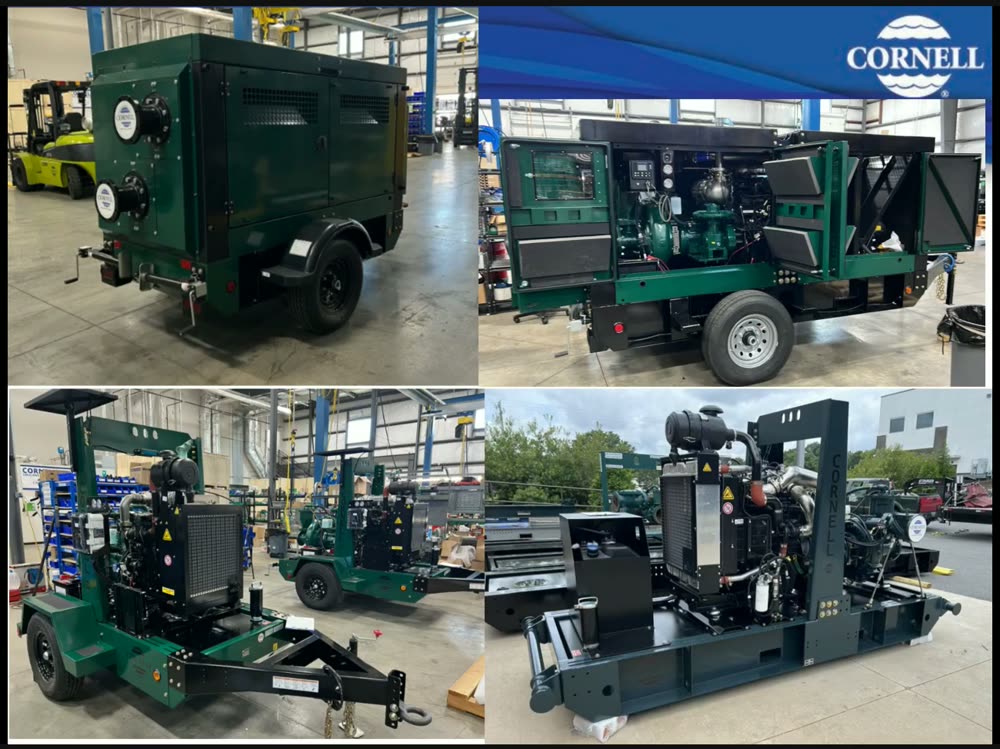
Built in Rock Hill, South Carolina, which grew from 35,000 to 80,000 sq ft in under two years. The enclosure was designed by a former rental service tech: every door opens fully, and suction and discharge come out the back so nothing blocks access.
Diesel trailers
Up to 136 hp and 8″ pumps (bigger means a double axle and a new design)
Electric skids
Up to 12″ pumps and 350 hp, with VFDs available; popular at mines
Lead time
Cornell quoted 6–10 weeks on small diesel trailers when others were at 16–18
Diesel trailers and skids from Rock Hill.
Rhino can also package Cornell pumps on our own skids.
In the recording: trailers from about 20:23, food handling and refrigeration 25:50, clear liquid 57:10, self-primers 1:10:20, N series 1:25:50, MP and MX 1:34:52.
Part 3 · Design features
What you'll sell Cornell on
Tap each one to see how it works and what to tell a customer.
Cyclo-Seal: a self-cleaning seal area
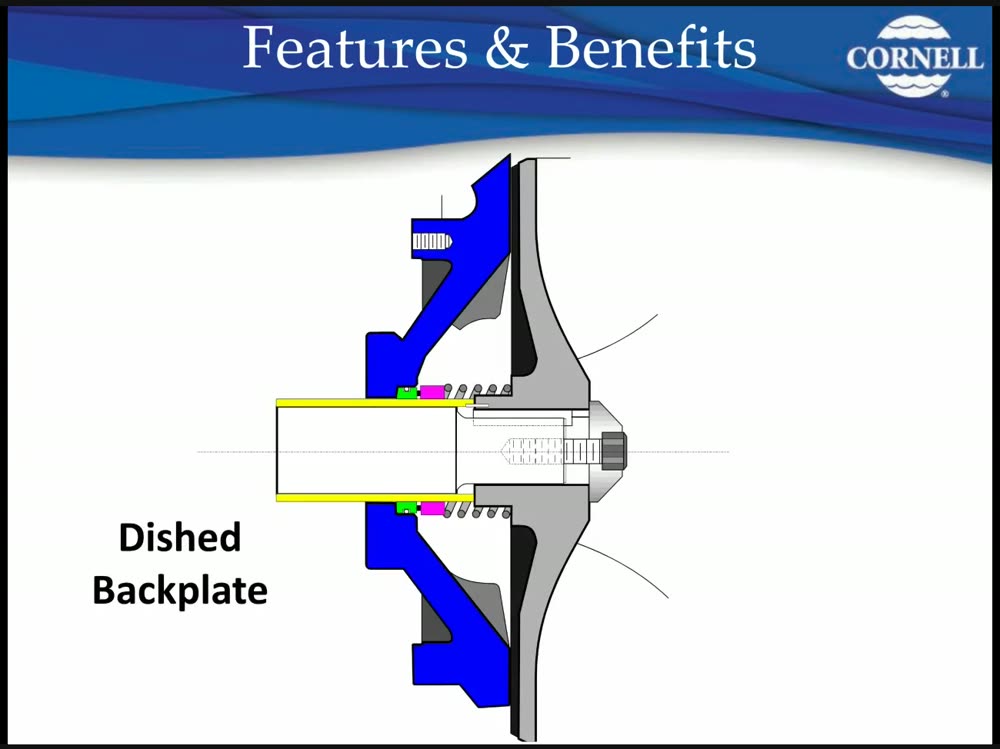
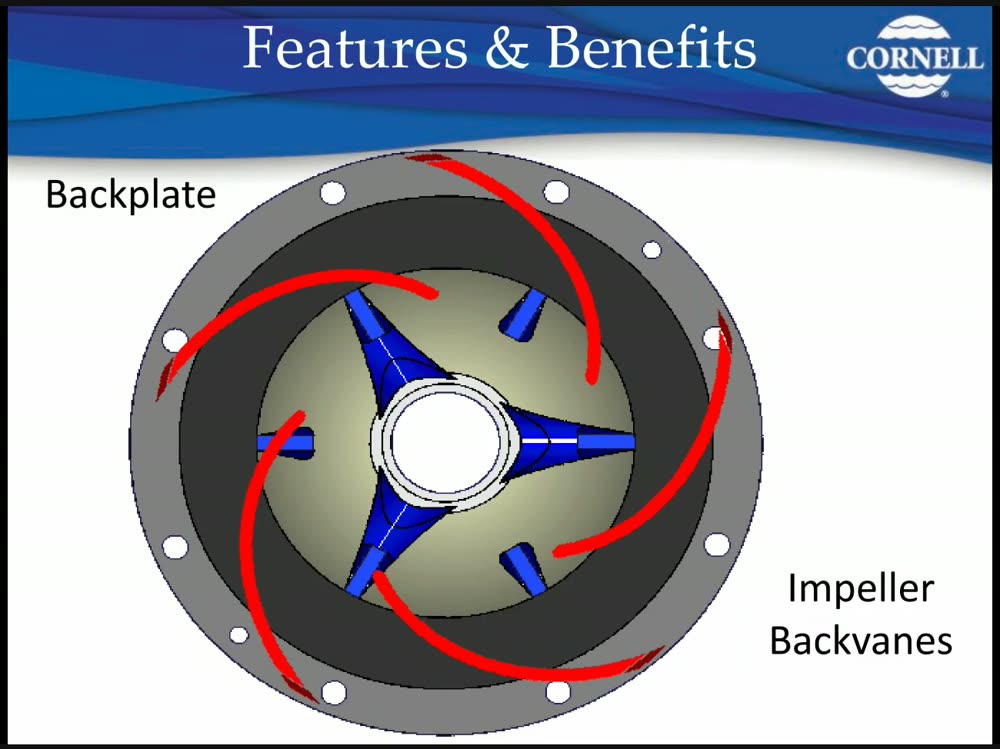
On 90–95% of builds. The seal itself is an ordinary type 1 or type 2 component seal. What makes it work is the dished backplate with cast-in deflector vanes, plus pump-out vanes on the back of the impeller. Together they make a vortex that throws sand and grit against the deflectors and out to the discharge. No flush water, no grease. Only add flush water for very fine material that won't leave, such as talc or 15–20% silica sand.
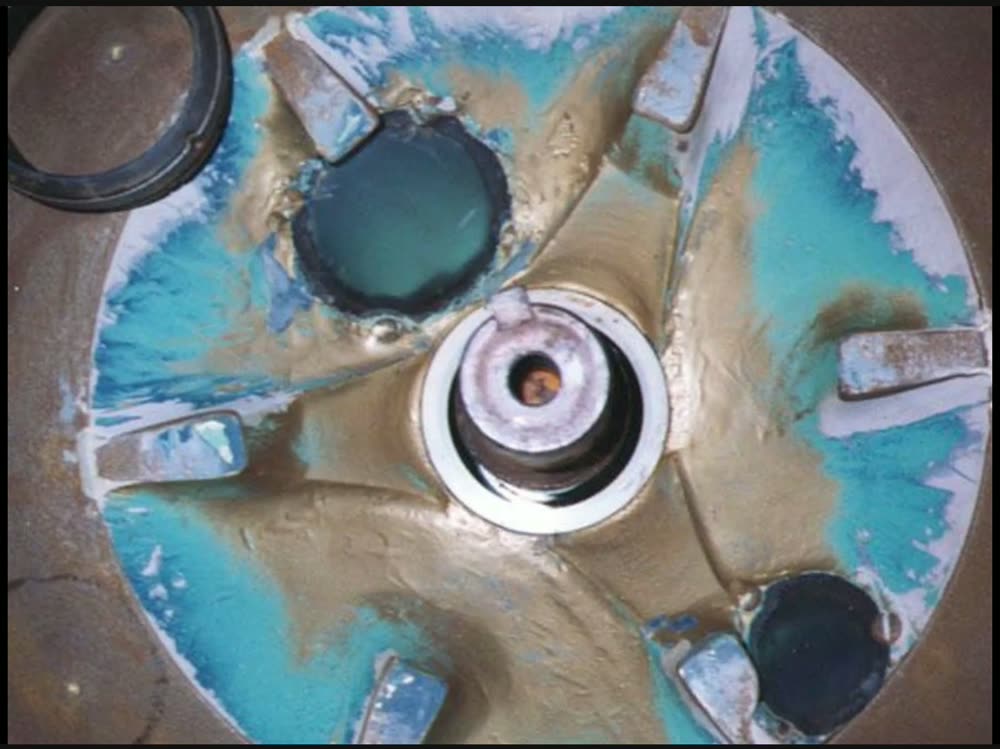
The paint test that proved Cyclo-Seal
Cornell painted three layers on a seal chamber and ran 15% silica sand through it. Afterward, the paint near the seal was untouched, and the wear marks were on the deflector vanes, worn to bare metal. The sand was moving away from the seal. (The deflector vanes were the patented part; the patent has expired.)
Double volute: balanced radial loads
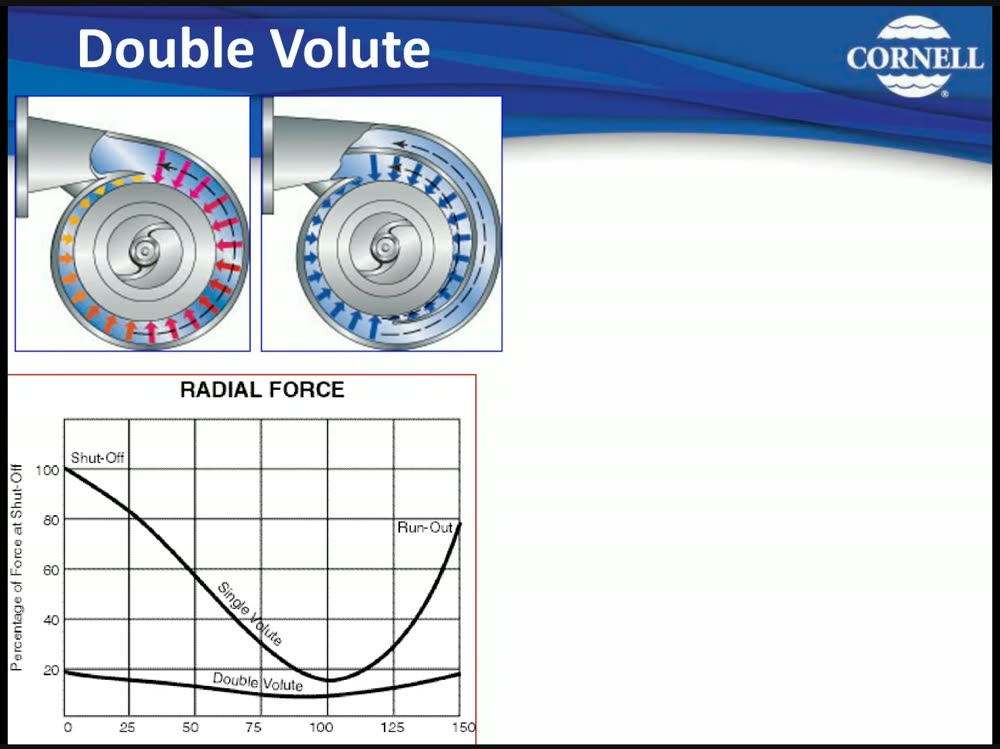
A second cutwater cast into the volute balances the radial force on the impeller. Off best efficiency point, radial load drops sharply, which protects shafts, bearings, seals and couplings. Standard on all pumps 8″ and up, water pumps 4″ and up, and high-head models such as the 4HH, 5HH and MX. Cornell says no customer has ever complained of a double volute clogging.
Hydraulic balancing on water pumps
Instead of drilling balance holes in the impeller, a balancing line runs from the seal area to the front of the impeller. No turbulence at the eye, so better NPSH and efficiency than most competitors. It's the odd-looking tube on the side of the pump.
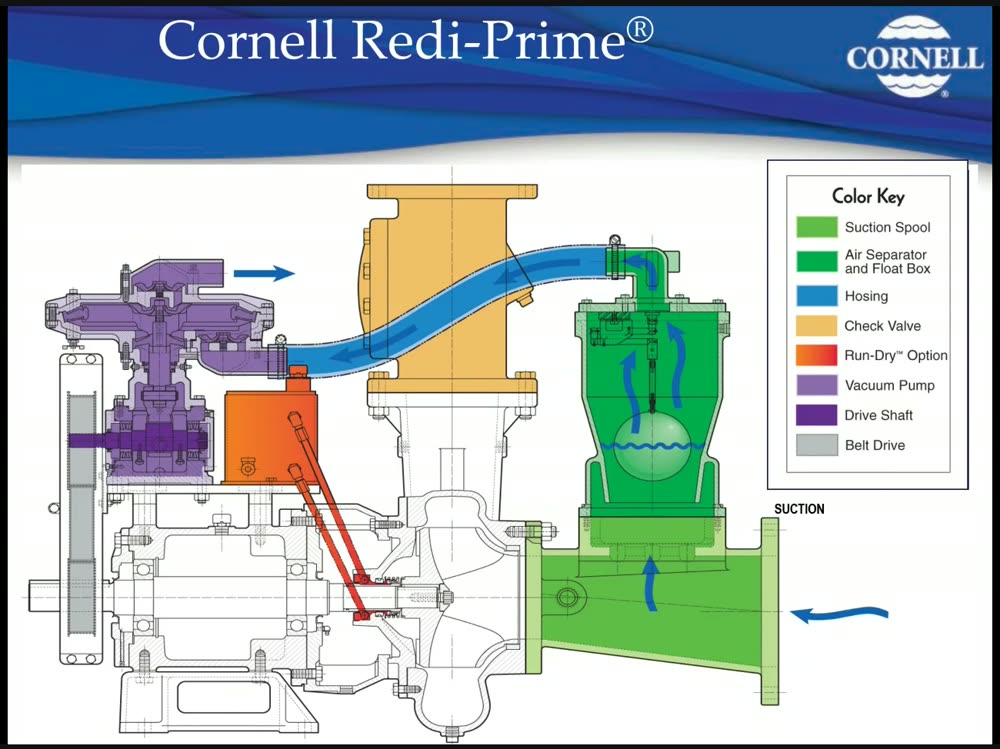
Redi-Prime: vacuum-assisted priming
Fits any pump 2½″ or larger. An oversized spool piece on the suction, a float chamber, and a belt-driven vacuum pump (rated 50 CFM, about 30 CFM actual) evacuate the air so liquid rises and the pump primes. A check valve on the discharge is required. It isn't sold on its own, only on a pump. Electric packages go up to 350 hp. In field test now: a serpentine belt (no teardown to change it) and a clutch so the vacuum pump doesn't run all the time.
Run-dry system
Comes with every Redi-Prime, because the seal runs dry while priming. A thermal cycle draws propylene glycol (RV antifreeze) around the seal. It can be added to any pump, but the presenter wouldn't unless the pump truly could run dry: it's one more seal to wear out.
Self-primer pressure relief underneath
A self-primer needs a pressure relief valve in case the discharge plugs. Competitors put the port where contractors rest their feet and break it. Cornell put it underneath, out of reach. Tip: if a self-primer loses prime, the backplate wears by design and can be readjusted. Many people scrap a pump that just needs adjusting.
Heavier than the Gorman-Rupp equivalent
Size for size, Cornell's self-primers have a bigger shaft, seal and bearings, a 17-4 PH stainless shaft, and 4130/4150 alloy shaft sleeves. A common failure on other self-primers is shaft corrosion inside the stuffing box; Cyclo-Seal avoids it. Most knockoffs on the market copy the Gorman-Rupp design.
Cyclo-Seal: the dished backplate.Deflector vanes and impeller back vanes.The paint test: wear on the vanes, not the seal.Radial force, single vs. double volute.
Redi-Prime: spool piece, float box, vacuum pump and belt drive.
Self-primer or Redi-Prime?
Self-primer (STX/STL/STH)
Redi-Prime
How it primes
Fill the casing once; it "burps" air out slowly
Vacuum pump pulls the air out; much faster on long suction lines
Efficiency
About 55–60%
70s to 80s
Price
Lower
Significantly higher, roughly double
Best for
4″–8″, modest flows
Above roughly 3,000–4,000 gpm, or where efficiency and maintenance matter
In between, run the curves. If you package your own Redi-Prime pump on a motor or engine, get the belt and sheave sizes from Cornell engineering so you don't overspeed the vacuum pump.
In the recording: Cyclo-Seal from about 38:18, double volute 45:04, Redi-Prime 47:55, self-primer vs. Redi-Prime 1:02:35, Gorman-Rupp comparison 1:54:06, pressure relief 1:58:21.
Part 4 · Quoting & lead times
Get the details up front, and ask early about lead times
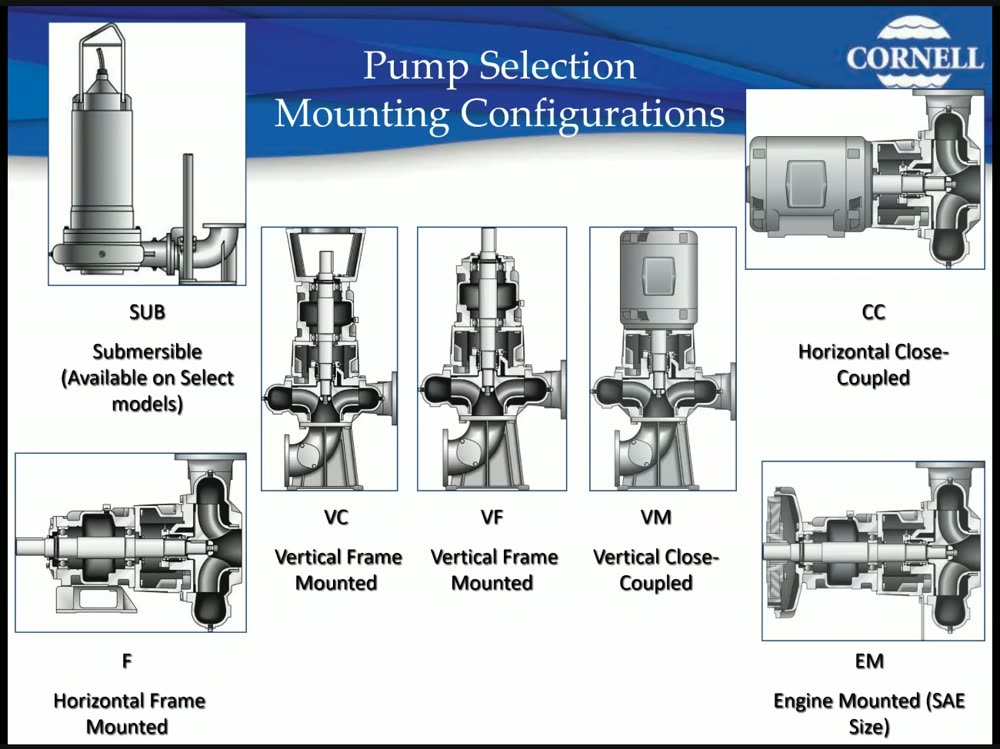
Almost every Cornell pump can be built several ways, so "what's the price on a 6″?" can't be answered until you say which build.
Mounting configurations: SUB, VC, VF, VM, CC, F and EM.
What to collect before you ask for a quote
Duty: flow, head, the liquid and its solids, suction conditions (lift or flooded).
Configuration: frame-mounted or close-coupled, horizontal or vertical, motor or engine.
Seal and materials: Cyclo-Seal unless there's a reason not to; anything else goes to engineering.
End market: municipal, industrial, mining, and so on.
DoUse the price book for budget numbers (expect roughly ±10%). It also decodes Cornell's model names. Then get a formal quote before you commit a price.
Don'tSell a close-coupled pump above about 40–50 hp unless space forces it. Above 50 hp the motor becomes a custom TCC build, and a replacement can take around 20 weeks. Frame-mount it instead.
Why orders sit in engineering
After you place an order, Cornell engineering does a design review to confirm sizing (for example, whether a big frame needs double roller or triple bearings). That's usually what delays an acknowledgment, not the inside salesperson. Average turnaround is about 5–6 days and has improved with new engineering hires.
Levers when a lead time is too long
Lever
How it helps
Ask the Cornell regional manager right away
The fix is often hidden: a material swap (say, a ductile or CD4 backplate already on the shelf) at no extra charge
Stock pumps
Cornell is building common configurations to the shelf again
Ship now, upgrade later
For example, ship with packing and swap to a seal a few weeks later
Pump-end-only (PEO) kit
When the motor is the long pole on a close-coupled pump, ask whether a kit fits a motor we can get faster
Watch the season
Irrigation pumps such as the 4RB get slow during irrigation season
Don't lose a job to lead time quietly. Cornell said plainly they would rather work something out than lose the order, so ask before the bid goes away.
Working with Cornell
Send inquiries to the market's general sales email (industrial, mining, parts and so on) and copy Cornell's regional manager. A general inbox reaches the whole team and its market manager, so nothing sits while someone is out. Expect thinner coverage in summer.
Parts: Cornell's e-commerce site looks up parts by serial number and shows drawings. If you need a drawing that isn't there yet, ask and it gets prioritized.
NSF 61: Cornell has submitted its entire line (wastewater, mining, Redi-Prime, self-primers) to UL and expects full NSF 61 certification by the end of 2027. Until then, confirm the specific model.
Installation photos: Cornell wants pictures of Rhino installs for their presentations.
In the recording: mounting configurations from about 36:30, close-coupled vs. frame-mounted 56:12, NSF 61 1:00:18, price book 1:29:36, engineering review 1:41:57, lead-time levers 1:46:12.
Part 5 · Scenario drill
Which Cornell product fits?
Eight real-world requests. Pick the best fit. Score 6 or more to pass.
Part 6 · Knowledge check
Ten questions to finish
Score 8 or more to pass.
Watch the full session recording2 hours 24 minutes · the room recording this training is based on (rhinopumps.com sign-in)
2:56Cornell history5:56Ownership & Xylem8:59Oregon factory & test lab17:33Product lines & markets20:23Trailers, skids & South Carolina25:50Food handling & refrigeration30:39Immersible motors & installs36:30Mounting configurations38:18Cyclo-Seal45:04Double volute47:55Redi-Prime & run dry54:26Impellers & cutters56:12Close-coupled vs. frame57:10Clear liquids & NSF 611:02:35Self-primer vs. Redi-Prime1:10:20STX, STL & STH1:25:50N series1:29:36Model names & price book1:32:13Castings & machining1:34:52MP slurry & MX high head1:41:57Quoting & engineering review1:46:12Lead-time levers1:54:06Gorman-Rupp comparison1:58:21Pressure relief design
Built from the session recording, its meeting notes and Cornell's presentation slides. Confirm specifications, certifications, pricing and lead times with Cornell before quoting.